Request a Demo
On Dec. 25, China National Medical Products Administration (NMPA) published an article entitled “Identifying Cosmetics Illegal Claims and False Advertising," which clarifies the definition of cosmetics and proposes specifications for cosmetics claims in line with requirements stipulated in Administrative Provisions on Cosmetic Labeling, Cosmetic Naming Regulations, and Guidelines on the Naming of Cosmetics.
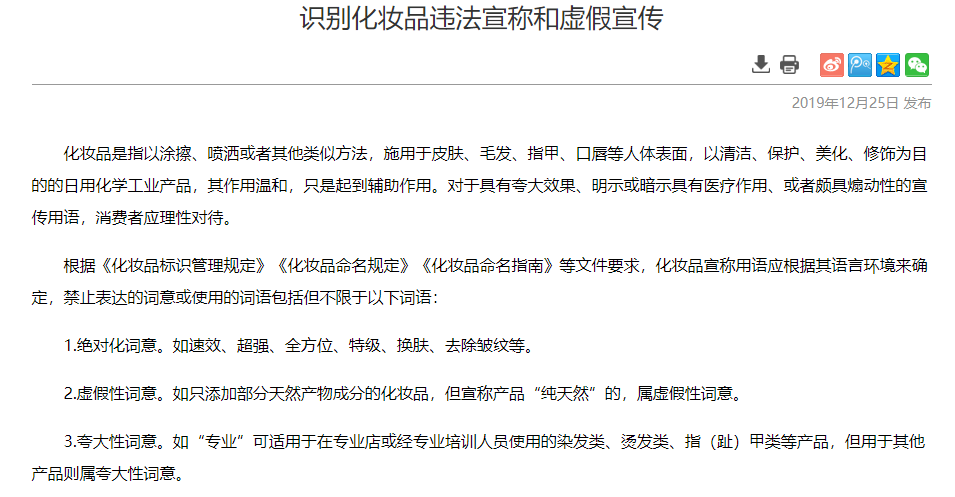
As per the article, whether certain words and expressions are allowed to be used in cosmetics claims shall be determined by the context. The words prohibited to be expressed or used shall include but not be limited to the following content:
Use of hyperbole, superlatives, and absolute terms. Terms such as rapid effect, super-powerful, all-round, superior, best in class, unbeatable, etc.
False claims. For example, claiming a cosmetic is natural when some of its ingredients are synthetic
Exaggerated meaning of words. For example, the word “professional” can be applied to the products such as hair dyes, hair perms, and finger (toe) nails used in professional beauty salons or by professionally trained personnel, but it falls under the scope of words with exaggerated meaning if used for other products.
Medical terms, words conveying, explicitly or implicitly, medical functions, and effects. Such as prescription, medicinal, therapy, detoxification, anti-allergy, anti-bacterial, anti-freckle, removing scar, hair growth, lipolysis, slimming, names of various types of skin diseases, and names of various diseases.
Names of medical celebrities. Such as Bian Que, Hua Tuo, Zhang Zhongjing, and Li Shizhen.
Approved names of drugs, such as "Fu Man Ling."
Use of words that are irrelevant to the characteristics of the products and are not easy for consumers to understand. Such as decoding, digital, intelligent, and infrared.
Vulgar meaning of words. For example, “裸 (‘nude/naked’ in English)” falls under the scope of words with vulgar meaning if used in “裸体(not wearing any clothes)," however, it is allowed to be used in “裸妆(nude makeup)” (in the case of makeup products).
Words with feudal or supernatural connotations. Such as ghosts, goblins, divinatory symbols, evil, and soul. Another example, “神 (god)” falls under the scope of words with feudal superstitious meaning if used in “神灵(gods)”; however, it is allowed to be used in “怡神(refreshing)” (in the case of aromatic cosmetics).
Claiming the product usage extends beyond the regulated scope. For example, claiming a "non-special use" cosmetic has the functional efficacy of a "special-use" cosmetics. Claims shall not exceed the interpretation of the meaning of "special-use" cosmetics as stipulated in the Cosmetic Hygiene Supervision Regulations and its implementation rules. "Non-special use" cosmetics shall not claim the role of "special-use" cosmetics.
Implications for stakeholders
This NMPA release only serves as a support document on how to interpret cosmetic regulations such as the Guidelines on the Naming of Cosmetics.
This latest reminder by NMPA should be a wake-up call for the industry that Chinese authorities will enhance supervision over cosmetic claims and advertising, and clamp down on unfair competition and any practices that deceive consumers.
 We provide full-scale global cosmetic market entry services (including cosmetic registering & filing, regulatory consultation, customized training, market research, branding strategy). Please contact us to discuss how we can help you by