Request a Demo
Editor's Note: This article was originally published on November 22, 2022, and was updated on July 21, 2023, as per the latest developments.
In November 2022, EU notified WTO of a draft proposing to newly include 30 more CMR substances (those classified as carcinogenic, mutagenic or toxic for reproduction) into the prohibited ingredients list in Regulation (EC) No 1223/2009 (Cosmetics Regulation).1 On July 20, 2023, EU introduced the finalized amendments in Commission Regulation (EU) 2023/1490, which will officially take effect from December 1, 2023.2
Regulation 1272/2008 on Classification, Labelling and Packaging of Substances and Mixture (CLP Regulation) establishes a harmonized classification of hazardous chemicals, including CMR substances, within the European Community. Depending on their properties, the CLP Regulation further groups CMR substances under category 1A, category 1B and category 2. Article 15 of Cosmetics Regulation sets out provisions on the use of CMR substances in cosmetics. In order to thoroughly protect human health, as a general principle, CMR substances are banned for use in cosmetics.

On May 3, 2022, EU released Delegated Regulation (EU) 2022/692, which introduced chemicals newly classified as CMR substances. To uniformly prohibit these CMR substances from being used in cosmetics, EU therefore proposed this draft to transpose them into the Cosmetics Regulation, and scheduled to adopt the amendments from the same effective date as Delegated Regulation (EU) 2022/692.
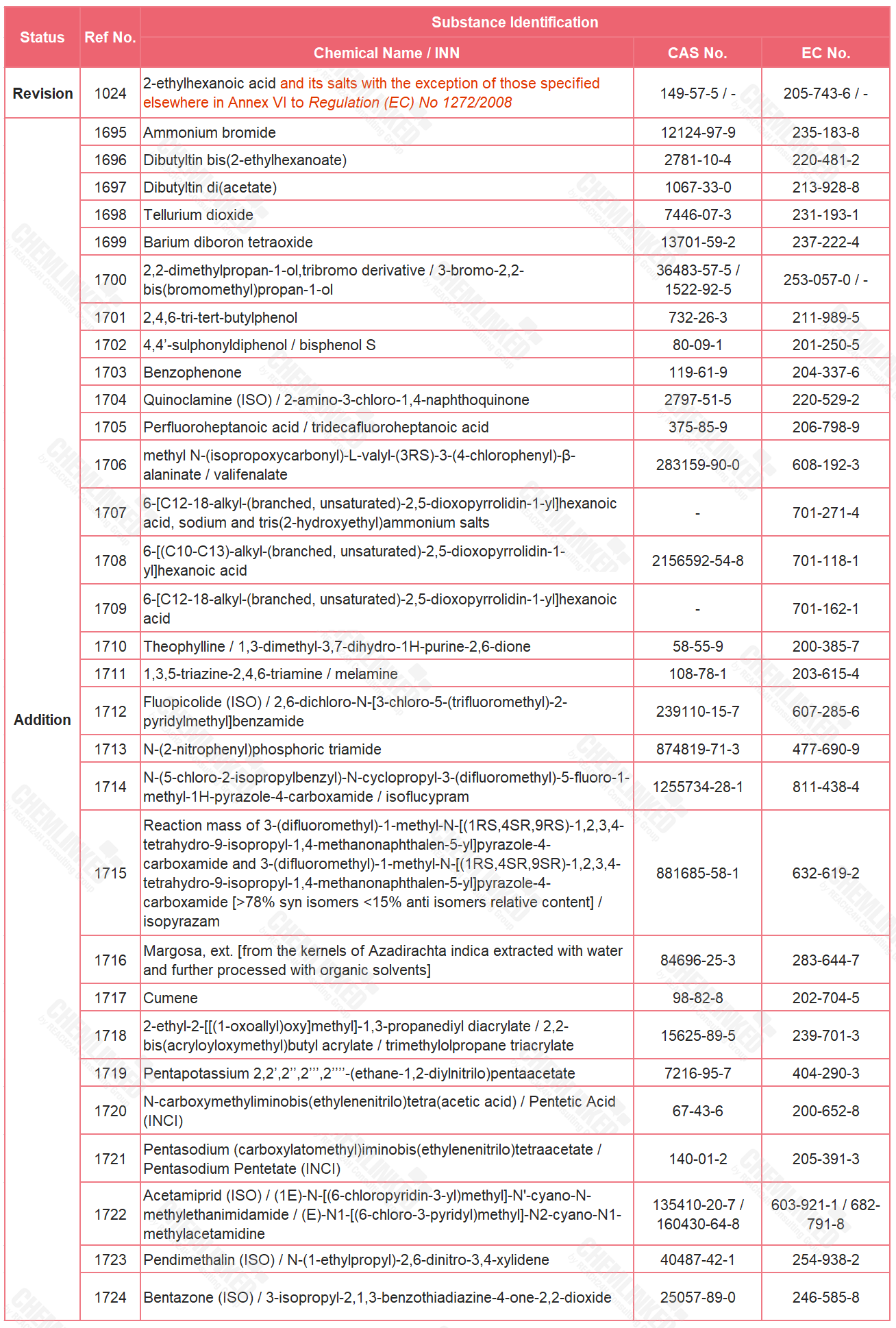
The basic information of the CMR substances to be banned is as follows (the text in red indicates changes to the previous list):
 We provide full-scale global cosmetic market entry services (including cosmetic registering & filing, regulatory consultation, customized training, market research, branding strategy). Please contact us to discuss how we can help you by