Request a Demo
The cosmetic regulatory framework in South Africa remains largely self-regulated, relying on standards, industry best practices, and guidelines to steer compliance. While its regulatory approach closely aligns with EU standards, it also incorporates some local requirements. South Africa does not mandate pre-market product notification or registration. Instead, companies should focus on key areas such as ingredient restrictions, product safety, labeling and advertising requirements.
Part 1 Regulatory Framework and Competent Authority
1.1 Main Cosmetic Regulations
The primary legislation governing cosmetics in South Africa is the Foodstuffs, Cosmetics and Disinfectants Act 54 of 1972, passed on May 19, 1972, and effective from January 1, 1973. Clause 15 of the Act empowers the Minister to issue regulations for cosmetic products under its scope. Based on this provision, the National Department of Health (NDoH) released a draft regulation in 2016 titled Regulations Relating to the Labelling, Advertising, and Composition of Cosmetics, followed by a revised version in December 2017. However, due to limited government capacity and resources, the draft has yet to be finalized or enforced. The draft demonstrates the intention of the South African government to regulate this industry and focus on the critical areas of labelling, composition, advertising and post marketing surveillance that require enforcement.
While the decision to formalize these regulations is still pending, the Cosmetic Toiletry & Fragrance Association of South Africa (CTFA) has stepped in to support the industry by issuing the Cosmetic Compendium. This guideline helps companies align with the draft Regulations Relating to the Labelling, Advertising, and Composition of Cosmetics and is regularly updated to reflect evolving product trends, standards, and ingredient annexes—largely based on the EU’s Regulation (EC) No 1223/2009.
Additionally, the South African Bureau of Standards (SABS) develops national cosmetic standards in response to market needs. Most of the cosmetic standards are voluntary and used as industry guidelines, without imposing mandatory compliance.
Regulation | Effective Date |
Foodstuffs, Cosmetics And Disinfectants Act, 1972 (Act No. 54 of 1972) | January 1, 1973 |
March 31, 2011 | |
May 19, 2014 | |
Regulations Relating to the Labelling, Advertising, and Composition of Cosmetics, 2017 | Draft |
February 6, 2025 | |
/ | |
2021 | |
May 2025 |
1.2 Competent Authority
1.2.1 National Department of Health (NDoH)
There is currently no official guidance on which administrative authority in South Africa will be responsible for the implementation and enforcement of the cosmetic regulations. Although it is often assumed that the South African Health Products Regulatory Authority (SAHPRA) may take on this role, cosmetic products are not currently within SAHPRA’s formal regulatory mandate.
Furthermore, given SAHPRA’s existing resource limitations, it is unlikely the authority would be able to take on additional enforcement responsibilities at this time. As such, it is expected that regulatory oversight will remain with the NDoH, under the framework of the Foodstuffs, Cosmetics and Disinfectants Act, 1972.
1.2.2 Cosmetic Toiletry & Fragrance Association of South Africa (CTFA)
CTFA has been active for many years, supporting its members by providing up-to-date information on regulatory controls related to cosmetics and personal care products. This includes technical expertise and guidance on matters such as ingredients, labeling, packaging, and product claims. While the CTFA provides guidance based on international norms, it functions as a voluntary industry body and does not have regulatory or enforcement authority.
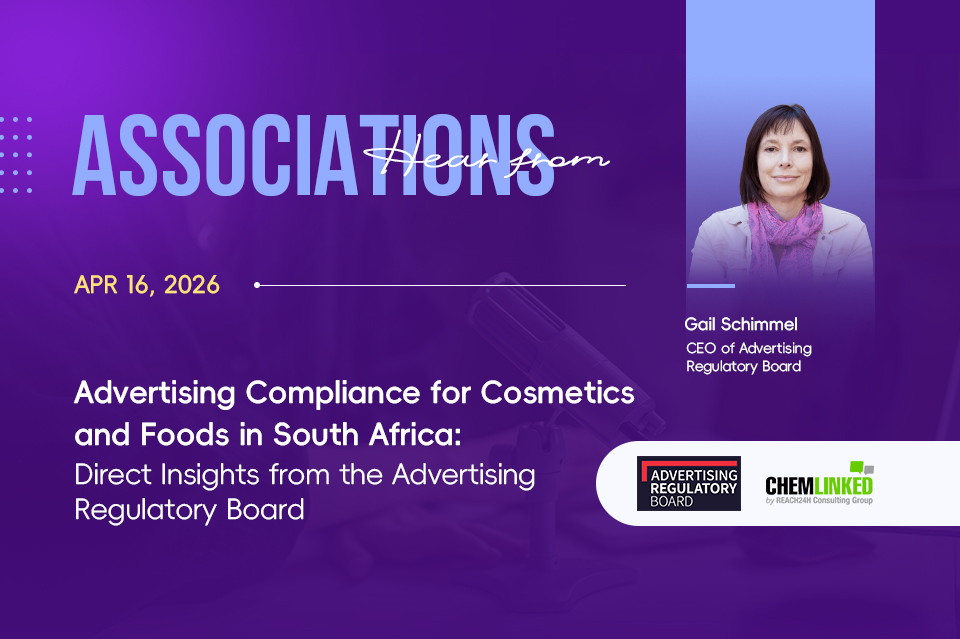
1.2.3 Advertising Regulatory Board (ARB)
ARB is an independent body tasked with administering the Code of Advertising Practice. It regulates product advertising to ensure an effective self-regulatory system that protects consumers. However, as a self-regulatory entity, the Code is not legally binding and serves primarily as a guidance document for specific advertising-related issues.
1.2.4 South African Bureau of Standards (SABS)
SABS serves as the national authority for standards and accreditation. It is responsible for developing and maintaining South African National Standards (SANS), such as standards relevant to cosmetic product labeling. Most of these standards are voluntary and used as industry guidelines, without imposing mandatory compliance.
1.2.5 National Regulator for Compulsory Specifications (NRCS)
NRCS was established to promote public health and safety, protect the environment, and ensure fair trade. The NRCS is mandated to develop and enforce compulsory specifications and technical regulations, and to conduct market surveillance to ensure industry compliance with these legal requirements.
Part 2 Cosmetic Compliance Requirements
2.1 Cosmetic Definition
In South Africa, cosmetic means any article, preparation or substance intended to be rubbed, poured, sprinkled or sprayed on or otherwise applied to the human body, including the epidermis, hair, teeth, mucous membranes of the oral cavity, lips and external genital organs, for purposes of cleansing, perfuming, correcting body odours, conditioning, beautifying, protecting, promoting attractiveness or improving or altering the appearance, and includes any part or ingredient of any such article or substance.
2.2 Ingredients
In the self-regulating environment locally, South Africa adopts the European Union (EU) as a model and as such the CTFA Cosmetic Compendium is based on the EU cosmetic regulation wherein one would find prohibited ingredients, restricted ingredients, and permitted colouring agents, preservatives and UV filters. It provides guidance on ingredient limits, applicable product categories, and required wording and warnings.
The relevant annexes of the CTFA Cosmetic Compendium include:
(a) Annex II: List of Substances Prohibited in Cosmetic Products
(b) Annex III: List of Substances Which Cosmetic Products Must Not Contain, Except Subject to Restrictions Laid Down
(c) Annex IV: List of Colouring Agents Allowed for Use in Cosmetic Products
(d) Annex V: List of Preservatives Allowed in Cosmetic Products
(e) Annex VI: List of UV Filters Allowed in Cosmetic Products
In addition to the ingredient annexes, South Africa has also introduced specific regulations governing the use of certain ingredients in cosmetics, including mercury, CMR substances, persistent organic pollutants, and hazardous chemical agents, etc.
2.3 Product Safety Requirements
South Africa does not require cosmetics to undergo registration or notification before being placed on the market. However, the responsible person—whether an individual or a legal entity such as the manufacturer, importer, or distributor—remains accountable for ensuring the product’s compliance with all applicable regulations. This includes maintaining a Product Information File (PIF), adhering to Good Manufacturing Practices (GMP), and meeting heavy metal and microbiological limits.
 2.4 Labeling, Claims and Advertising
2.4.1 Labeling
All information required to appear on cosmetic product labels must be visible, legible, and indelible. The legibility must not be compromised by pictorial elements or any other printed matter. Additionally, prohibited claims are strictly not permitted on cosmetic labels. Labels must be written at least in English.
Both primary and secondary packaging must meet minimum labeling requirements, as outlined in the draft Regulations Relating to the Labelling, Advertising, and Composition of Cosmetics.
In addition, net content labeling for cosmetics is governed by the Legal Metrology Act and SANS 289:2022 – Labelling Requirements for Pre-packaged Goods.
2.4.2 Claim and Advertising
All claims and advertising in all forms can refer to the principles outlined in the ARB's Cosmetic Advertising Code of Practice. Cosmetic enterprises must ensure that their claims and advertisements:
Comply with all applicable legislation;
Are sincere, truthful, and not misleading;
Enable consumers to make informed choices;
Reflect ethical and socially responsible practices;
Are supported by substantiation, whether the claim is explicit or implied, and such evidence must be made available within a reasonable timeframe when requested;
Fall strictly within the defined scope of cosmetic products.
2.5 Post-market Surveillance
The Draft Regulations Relating to the Labelling, Advertising, and Composition of Cosmetics proposes that manufacturers implement a post-marketing surveillance (PMS) system. This system should include procedures to investigate and document undesirable and serious undesirable effects, record them in the PIF, and regularly review the data to identify trends and take corrective action when necessary. However, the draft does not require reporting to a regulatory authority.
Should you require the full version of the cosmetic regulation report, please feel free to reach out at [email protected]. Our team will be pleased to provide you with the full documentation to help you navigate the South African cosmetic framework.
Webinar Recommendation