

 Request a Demo
Halal cosmetics refer to personal care products that comply with Islamic law. These products must be free from any prohibited (Haram) or impure (Najis) substances. Under Islamic law, Haram substances include blood, carrion, pork, alcoholic beverages, human body parts, and animals not slaughtered according to halal practices. Najis substances include pigs and their derivatives, as well as human waste. In addition to ingredient restrictions, halal cosmetics must adhere strictly to halal standards throughout the entire supply chain—from production and processing to packaging and storage—to ensure that products remain uncontaminated.
Among ASEAN countries, Indonesia and Malaysia are the leading nations with clear and comprehensive regulations for halal-certified cosmetics. With their majority Muslim populations, these countries place strong emphasis on halal certification across sectors such as food, cosmetics, and pharmaceuticals. Singapore and the Philippines also show growing demand for halal-certified products, especially among their Muslim consumers. While Thailand and other ASEAN countries currently have lower overall demand, the expansion of the global halal market is increasingly driving both consumer demand and regulatory attention toward halal certification.
It is important to note that so far there’s no single global standard for halal certification. Certification bodies, requirements, and procedures vary from country to country. Companies must comply with the specific regulations and certification processes of each market they wish to enter.
The following section details the halal certification process and requirements, as well as halal logo labeling requirements for cosmetics in various ASEAN countries, including Indonesia, Malaysia, Singapore, Thailand, Philippines and Vietnam.
 1. Indonesia
Indonesia is the fourth most populous country in the world, with approximately 280 million people—over 87% of whom are Muslim. As a result, halal-certified products are of great significance. Among similar products, Muslim consumers are more likely to choose those with halal certification label.
To provide consumers with clear assurance regarding the halal status of products, Indonesia enacted Law No. 33 of 2014 on Halal Product Assurance (HPA Law) on October 17, 2014, which officially came into effect on October 17, 2019. According to Article 4 of the HPA Law, all halal products and related services imported, distributed, and traded in Indonesia must be certified halal if they fall within the categories of cosmetics, food, beverages, medicines, chemical products, biological products, or genetically modified products. Mandatory halal certification for cosmetics is set to begin on October 18, 2026.
Products that have received halal certification must bear a Halal label on their outer packaging. Conversely, products that are not certified as halal must include non-halal information on the label to clearly indicate their status.
1.1 Key Halal Regulations
Regulation | Main Content | Implementation Date |
Law of the Republic of Indonesia No. 33 Year 2014 concerning Halal Product Assurance (HPA Law) | The law stipulates that, as of October 17, 2019, all halal products imported, distributed, or traded in Indonesia—as well as services related to cosmetics, food, beverages, medicines, chemical products, biological products, and genetically modified products—must be halal-certified. | October 17, 2019 |
Amendments to Law of the Republic of Indonesia No. 33 Year 2014 concerning Halal Product Assurance | The amendment significantly shortens the halal certification timeline, reduces the compliance burden on businesses, and clearly delineates the respective responsibilities of BPJPH and MUI. | November 2, 2020 |
The decree provides an extensive list of ingredients and materials that are inherently halal and therefore exempt from the halal certification requirement. | December 27, 2021 | |
BPJPH Decree No. 40 of 2022 concerning the Determination of the Halal Label | The decree outlines the halal logo and labeling standards. | March 1, 2022 |
The amendment introduces clear labeling guidelines for products bearing halal certificates issued by overseas halal institutions (LHLN) when entering the Indonesian market. | November 1, 2023 | |
BPJPH Decree No. 221 of 2025 on Procedures for Foreign Halal Certificate (SHLN) Registration | This decree establishes the updated procedures for registering foreign halal certificates with BPJPH. | December 15, 2025 |
The decree establishes the procedures for registering foreign halal certificates with the relevant authorities in Indonesia. | November 15, 2023 | |
Government Regulation (GR) 42/2024 Concerning Implementation of Halal Product Assurance | The regulation refines Government Regulation No. 39/2021 and aims to enhance legal clarity and provide assurance to the public regarding the halal status of products entering, being circulated, and being traded in Indonesia. | October 17, 2024 |
BPJPH Decree No. 170 of 2025 Concerning Guidelines for Supervision of Halal Product Assurance | The decree establishes comprehensive guidelines for the supervision of Halal Product Assurance, transitioning from a time-based certification model to continuous supervision since the expiry limit of halal certificates was removed. | July 31, 2025 |
1.2 Competent Authorities
1.2.1 BPJPH
The Badan Penyelenggara Jaminan Produk Halal (BPJPH), or the Halal Product Guarantee Agency, was established in 2017 to gradually assume responsibility for halal certification in Indonesia. On October 17, 2019, BPJPH officially took over the role previously held by MUI’s Food, Drug and Cosmetics Assessment Body (LPPOM MUI) in managing the halal certification process.
1.2.2 MUI and LPPOM MUI
The Majelis Ulama Indonesia (MUI) is the leading and most credible Islamic authority in Indonesia. Prior to the establishment of BPJPH, MUI was the sole institution responsible for halal certification, overseeing the entire process for more than two decades.
Operating under MUI, the LPPOM MUI was specifically tasked with conducting halal certification assessments for cosmetics, food, and medicines before BPJPH established.
Under the HPA Law, MUI continues to play a central role by issuing the Halal Fatwa, following deliberations by the Halal Fatwa Assembly. This declaration serves as a confirmation that a product complies with Islamic Syariah principles and forms the basis for the halal certificate issued by BPJPH.
1.3 Requirements for Halal Cosmetics
In Indonesia, cosmetics must meet the following requirements to obtain halal certification:
1. According to Islamic law, Ingredients must be free from any haram substances which are forbidden.
2. Manufacturing processes must have no contamination with haram substances and be porcine-free.
3. Company implements Sistem Jaminan Produk Halal (Halal Product Assurance System, SJPH). SJPH is a quality management system outlined by BPJPH, which should be implemented by a company applying for BPJPH’s halal certificate. SJPH criteria comprise 5 points: (1) commitment and responsibility, (2) materials, (2) halal product process, (3) products, (4) monitoring, and (5) evaluation.
1.4 Halal Certification Procedures
Foreign companies may choose one of the following two methods for halal certification compliance in Indonesia:
1. Application of a Halal Certificate via BPJPH
2. Registration of Foreign Halal Certificates (RSHLN)
1.4.1 Procedures for Halal Certificate Application via BPJPH
1. Halal Certification Application
Business operators must submit their halal certification application to BPJPH through the electronic system SIHALAL. Applications of imported products must be submitted by importers or representatives based in Indonesia.
BPJPH is required to review and confirm the completeness of the submitted documents within one working day of submission.
2. Appointment of LPH
Upon confirming document completeness, BPJPH will appoint a Halal Inspection Agency (LPH) to conduct an assessment and/or testing of the product’s halal status. This appointment shall be made within one working day.
3. Inspection and Testing by LPH
The LPH will carry out two key activities:
Document review; and
Inspection and/or testing of the product’s halal compliance, conducted by a halal auditor appointed by the LPH.
The document review must be completed within two working days of the LPH’s appointment. If additional information is needed, the applicant must submit the requested documents within two working days of receiving the request.
Upon completion of the document review, the LPH will submit the cost details for the halal inspection and/or testing to BPJPH. BPJPH will then issue a payment invoice through the system. The applicant must complete payment within five working days of the invoice date.
Note: Micro and small enterprises are exempt from halal certification fees.
The on-site halal inspection is conducted at the production facility during the manufacturing process. If any ingredient's halal status is uncertain, laboratory testing will be performed.
All inspection and testing must be completed within 15 working days for both domestic and imported products. LPH may request an extension up to 10 additional working days for domestic products and 15 days for imported products.
4. Submission of Results
LPH will submit the results of the product’s halal inspection and/or testing to the MUI, with a copy provided to BPJPH.
5. Determination of Product’s Halalness
MUI will organize a Halal Fatwa Assembly to determine the product’s halal status. The conclusion shall be reached within three working days of receiving the inspection results.
The Decree of Halal Product Determination (Halal Fatwa) will be issued by MUI and submitted to BPJPH as the basis for halal certificate issuance.
6. Issuance of Halal Certificate
If the Halal Fatwa Assembly declares the product’s halal status, BPJPH will issue the halal certificate within one working day. If the product is deemed non-halal, BPJPH will notify the business operator and return the application, including reasons for rejection, also within one working day.
7. Halal Certificate Renewal
The halal certificate remains valid from the date of issuance by BPJPH, provided the composition of materials and/or the Halal Product Process (PPH) remains unchanged. Should any changes occur, the business operator must apply for certificate renewal.
Figure 1: Procedures for Applying for a Halal Certificate via BPJPH
 1.4.2 Procedures for Registration of Foreign Halal Certificates
If an imported product is already with a halal certificate issued by a foreign halal certification body recognized by BPJPH through mutual recognition agreements, a new halal certificate is not required. However, the certificate must be registered with BPJPH prior to the product’s distribution in Indonesia.
1. Registration
The importer or authorized representative creates an account on the SIHALAL platform.
Log in and navigate to the SHLN Registration section.
Fill in applicant information and upload the required documents, including the letter of authorization, NIB, copy of the SHLN, HS code list, and warehouse data.
2. Document Verification
BPJPH will review the completeness and validity of the submitted documents.
If the documentation is incomplete or invalid, the importer/representative must provide the necessary corrections within 5 working days. Failure to do so will result in application cancellation.
3. Payment
If document verification is successful, BPJPH will issue an invoice.
Payment must be completed within 10 working days, otherwise the application will be canceled. Payment verification follows.
4. Issuance of RSHLN Number
BPJPH prepares a draft of the RSHLN number.
The draft undergoes electronic signature approval.
Once approved, the RSHLN Number is officially issued.
The validity period of the foreign halal certificate registration will be aligned with the validity period of the original certificate issued by the foreign halal institution.
The importer or authorized representative in Indonesia must submit a renewal application at least 60 working days before the certificate’s expiry.
1.5 Halal Labeling
Halal-certified products must label “Halal” on the outer packaging. Business operators that have obtained Halal Certificate must include the Halal Logo on:
Product packaging;
Specific part of the product;
Specific place of the product.
Halal logo must be easy to see and read as well as not easily erase, detach, and damage.
Additionally, businesses must publish their halal-certified products through their electronic media, social media, or promotional materials (such as catalogs, ads, or testimonial videos) by displaying the Indonesian Halal Label and mentioning BPJPH’s official social media accounts. The publication link must be reported to BPJPH.
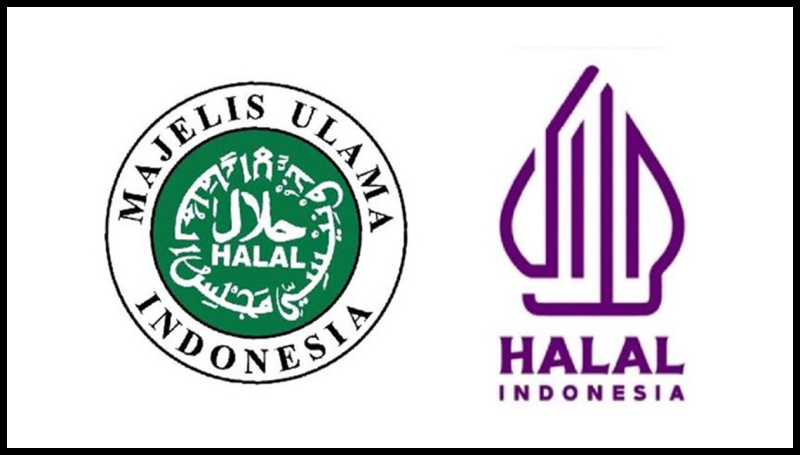
The new format of halal logo is determined by the BPJPH in BPJPH Decree No. 40 of 2022 concerning the Determination of the Halal Label and applied nationally. It must be shown on the product packaging as a sign of product halalness from March 1, 2022. The halal label previously issued by MUI can continue to be used on product packaging until October 17, 2026.
Figure 2: Indonesian Former Halal Logo (Left) and the New Halal Logo (Right)
1.6 Non-Halal Information Labeling (Draft)
Products originating from prohibited (haram) materials are exempt from the halal certification obligation but must bear Non-Halal Information. The Draft BPJPH Regulation outlines the criteria for haram materials (e.g., pork, alcohol, certain microbes) and non-halal production processes. The Non-Halal Information must be displayed as:
- For products (including cosmetics) from other haram materials or processes: The words "NON HALAL" in red capital letters inside a red rectangular box on a white background.
 The label must be placed proportionally, be easily visible, and not easily erased or damaged. Exceptions apply to very small packaging, which must use hang tags or other display methods. (Update note: Added a new section detailing the mandatory non-halal labeling requirements based on the Draft BPJPH Regulation on the Form and Procedure for Including Non-Halal Information and the Notification on Phased Implementation.)
1.7 Halal Product Assurance Supervision
With the elimination of the halal certificate expiration period, BPJPH shifted its focus to continuous supervision to ensure sustained compliance with the Halal Product Assurance System (SJPH). According to BPJPH Decree No. 170 of 2025, supervision is conducted periodically (once every 6 months) and incidentally (based on need or suspected violations).
Supervision covers:
1. Products: Checking halal status, halal labels, and non-halal information.
2. Business Operators: Ensuring consistent implementation of SJPH, physical separation of halal and non-halal processes, and the presence of a Halal Supervisor.
3. Halal Inspection Agencies (LPH) and Halal Auditors.
4. Halal Product Process Assistance Institutions.
If violations are found, BPJPH will issue recommendations for corrective actions. Continued non-compliance may lead to administrative sanctions or criminal prosecution
2. Malaysia
Malaysian Halal Certification is an official document stating the Halal status of products and/or services. Applicable scope includes consumer goods, cosmetic, food products, beverages, food supplements, etc. Notably, halal certification is mandatory for all animal products (excluding pork), while for other product categories (including cosmetics), it is highly advisable but not compulsory.
2.1 Key Halal Regulations
Regulation | Main Content | Implementation Date |
Trade Descriptions (Definition of Halal) Order 2011 & Its Amendment | This order defines the criteria for food and products to be considered halal, establishes the definition of “halal” and related terms, and sets out offenses and penalties for deceiving or misleading consumers regarding halal status. | / |
Trade Descriptions (Certification and Marking of Halal) Order 2011 & Its Amendment | This order designates JAKIM as the competent authority for halal certification, prohibits self-declaration of halal status, and requires that all products and consumables labeled as halal obtain official certification. Imported products bearing a halal logo must be certified by a halal certification body recognized by JAKIM. The order also establishes specific offenses and corresponding penalties for non-compliance. | / |
Trade Descriptions (Certification and Marking of Halal Fees) Regulations 2011 & Its Amendment | The regulation outlines the fees for certification. | / |
The standard outlines the requirements and scope for halal cosmetics across various aspects, including management responsibilities, materials, hygiene, sanitation, safety, manufacturing, handling, distribution, packaging, labeling, and advertising. | January 1, 2021 | |
The manual applies for halal certification requirements for Malaysian domestic product categories. It outlines the comprehensive requirements and procedures for halal certification, covering ingredient and product standards, processing, packaging, labeling, transportation, employee hygiene and welfare, sanitation, halal management systems, documentation, and contract manufacturing. Besides, it details the application conditions, certification schemes for various sectors (including cosmetics, food, drugs, medical devices, and logistics), internal halal control systems, application and modification processes, audits, monitoring, use of halal certificates and logos, sampling procedures, and the responsibilities of certificate holders. | January 1, 2021 | |
Malaysian Halal Certifications Procedure for International Manufacturing | The Circular outlines the five certification schemes under the Malaysian halal system, along with the eligibility requirements, application forms, and required documentation. | January 1, 2024 |
This guideline outlines the principles for establishing and maintaining a Halal Assurance System—an internal mechanism designed to monitor, control, improve, and prevent non-compliance in the production of halal products. | January 1, 2021 |
2.2 Competent Authorities
The Department of Islamic Development Malaysia (JAKIM) and the State Department of Islamic Religion Council (JAIN) of each state are the competent authorities responsible for certifying that food, products, or services related to these are halal.
JAKIM is responsible for developing national halal certification regulations and policies, as well as coordinating certification work across the states. JAIN implements the halal certification procedures within their respective states according to JAKIM’s regulation and policies.
2.3 Requirements for Halal Cosmetics
Halal cosmetics are products formulated with all ingredients that comply with Shariah law and fatwa, meeting specific conditions to ensure their permissibility. A brief summary of halal requirements is outlined below:
1. Raw materials and ingredients
a) Must not consist of or contain any part of matter of an animal that is prohibited by Shariah law or fatwa for a Muslim to consume, or that has not been slaughtered in accordance with Shariah law or fatwa;
b) Must be free from najis (impurities) as defined by Shariah law and fatwa;
c) Must not contain intoxicating substances;
d) Must not include any human parts or by-products prohibited by Shariah law and fatwa;
e) Must be non-poisonous and non-hazardous to health;
f) Must not be prepared, processed, or manufactured using equipment contaminated with najis;
g) Must not have been in contact with, mixed with, or stored near materials that violate the above conditions (a) and (b).
2. Processing and transportation
a) Equipment and processing aids must be easy to clean and free from materials classified as najis;
b) Manufacturing facilities must not contain any tools or elements associated with religious worship;
c) Equipment previously exposed to najs al-mughallazah (severe impurities) must undergo sertu (cleansing) procedures under supervision of a halal competent authority;
d) Processing lines converted from handling najs al-mughallazah to halal must be washed and sertu-cleansed, supervised by a halal authority, and thereafter dedicated solely to halal production, with no back-and-forth conversion allowed.
3. Packaging and labeling
a) Packaging materials must not be derived from any substances classified as najis according to Shariah law and fatwa;
b) Packaging must not be prepared, processed, or manufactured using equipment contaminated with najis;
c) Labeling materials that come into direct contact with the product must be halal and non-hazardous;
d) Halal cosmetics must not be named, or synonymously named, after non-halal materials or anything that could cause confusion.
4. Factory and premises
a) The premises must be located in an environment that, along with proper protective measures, ensures no risk of contamination by non-halal materials or products;
b) The premises must be effectively separated and insulated from pig farms or related processing activities to prevent contamination through air, water, sewage, personnel, or equipment;
c) The layout must support proper process flow, employee movement, hygienic practices, and safety measures, including protection against pest infestation and cross-contamination during operations;
d) The flow of products, from receipt of raw materials to finished goods, must be designed to prevent cross-contamination.
For complete and detailed requirements, stakeholders are encouraged to refer to MS 2634:2019 – Halal Cosmetics – General Requirements.
2.4 Halal Certification Procedures
Foreign companies may choose one of the following two methods for halal certification in Malaysia:
1. Applying for a Halal Certificate via JAKIM;
2. Certified as Halal by a foreign halal certification body recognized by JAKIM (List of recognized foreign halal certification bodies).
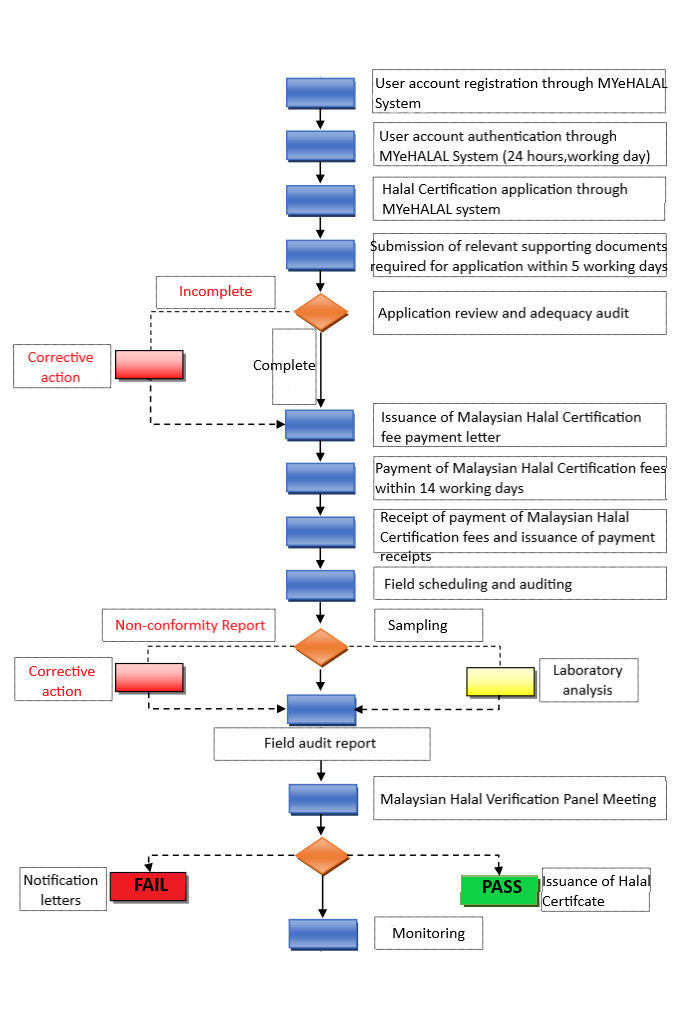
2.4.1 Procedures for Applying for a Halal Certificate via JAKIM
1. Online Application & Document Review
1) Halal certification applicants must submit their application via the MYeHALAL online system;
2) After completing the online submission, supporting documents must be submitted to JAKIM or JAIN;
3) For renewal applications, submission must be made at least three months prior to the expiry of the current halal certificate;
4) Incomplete applications will be automatically returned by the MYeHALAL system;
5) Once all required documents are verified, applicants will receive a payment invoice for the halal certification application.
2. On-Site Audit
1) On-site auditors must possess Islamic education and be familiar with halal auditing technical standards. They must not be members of the Halal Certification Panel. A minimum of two auditors is required.
2) Upon acceptance of the online application, the audit process begins. Audit areas include:
Document and archive review
Internal halal control system
Raw materials and production methods
Equipment, packaging, and labeling
Storage, manufacturing process, and transportation
Personnel handling, hygiene and sanitation systems
Waste management and facility layout
3) The audit process typically includes:
Opening meeting
Document verification
On-site inspection
Final evaluation
Closing meeting
4) Auditors are authorized to:
Access all production areas
Take photographs for documentation
Provide a copy of the audit report to the applicant
Conduct follow-up audits if corrective actions are required
5) Sampling and testing requirements:
Auditors may collect product and raw material samples for laboratory testing
Samples must be submitted to the Halal Certification Team for review
Testing costs are borne by the applicant
Laboratory analysis is conducted by an ISO/IEC 17025-accredited government laboratory, under the management of the Malaysian Chemistry Department
A re-audit may be conducted following the Halal Certification Team’s decision, but only once.
3. Malaysian Halal Certification Panel Meeting
1) Members of the Halal Certification Panel are formally appointed by JAKIM or JAIN for a two-year term;
2) Each group (JAKIM and JAIN) must consist of at least seven members;
3) The Certification Panel may make the following decisions:
Approved
Conditionally approved
Deferred for observation
Rejected
Re-audit required
Application canceled
4) All decisions made by the Halal Certification Panel are final. The final decision must be documented and archived, with official written notification sent to the applicant.
4. Issuance of Certificate
Once the Halal Certification Panel has approved the application, the official Malaysian Halal Certificate will be issued.
Figure 3: Procedures for Applying for a Halal Certificate via JAKIM
2.5 Halal Logo
Each product, upon approval by the halal competent authority, may be marked with the halal certification logo of that authority, provided the product conforms to the requirements of MS 2634: 2019 – Halal Cosmetics – General Requirements.
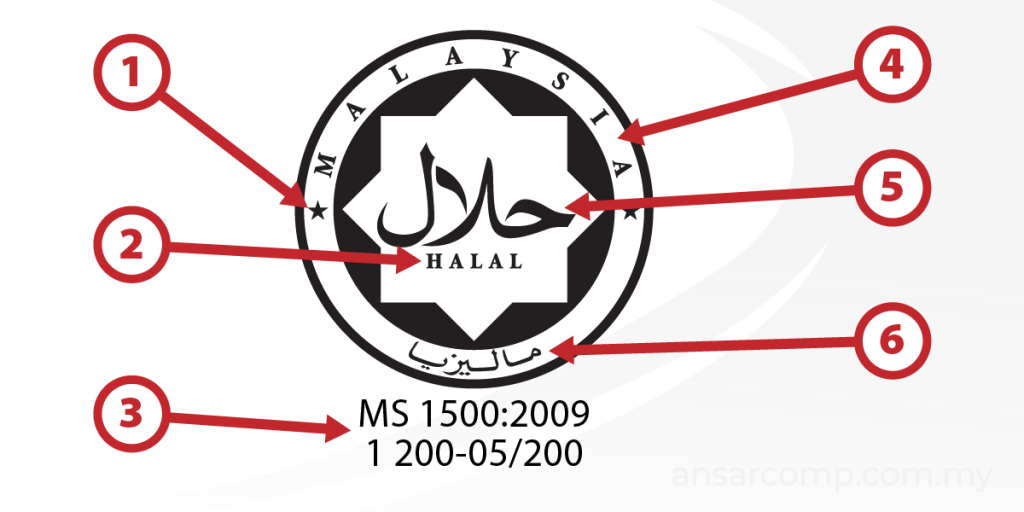
For products certified by JAKIM, the following Halal logo may be used, provided it meets these design and information requirements:
1. Two five-pointed stars positioned on the left and right sides of the circle, separating the words “MALAYSIA” and “ماليزيا”;
2. The word “HALAL” is displayed prominently at the center of the logo;
3. Top words indicates the applicable Malaysian Standard (MS) for the Halal certification. For example, MS 1500:2009 refers to the “Halal Food” standard;
Bottom words contains the last 10 digits of the file reference number from the Halal application. This number is unique and can be verified via the Malaysia Halal Directory Portal.
Note: The number shown in the diagram above is for illustration purposes only.
4. The word “MALAYSIA” is written along the top edge of the circle;
5. The Arabic word for “Halal” is displayed above the Romanised “HALAL” in the center;
6. The Arabic word for “Malaysia” is written along the bottom edge of the circle.
Figure 4: Malaysian Halal Logo
3. Singapore
In Singapore, Halal Certification is voluntary. It is governed under Section 88A of the Administration of Muslim Law Act.
3.1 Key Halal Regulations
Regulation | Main Content | Implementation Date |
AMLA empowers Majlis Ugama Islam Singapura (Muis) to issue and regulate Halal certificates for products, services, and activities, for ensuring compliance with Muslim law. It also governs the use of Halal certification marks and penalties for unauthorized use. | March 9, 2025 |
3.2 Competent Authorities
Majlis Ugama Islam Singapura (Muis), also known as the Islamic Religious Council of Singapore, was established in 1968 pursuant to the enactment of the AMLA. As a statutory board under the Ministry of Culture, Community and Youth, Muis oversees the administration of Muslim affairs in Singapore.
Muis is the sole authority responsible for Halal certification and the regulation of the Halal industry in Singapore. In addition, it serves as an advisor to the President of Singapore on all matters relating to Islam.
To continuously enhance the credibility of Muis Halal certification, Muis implemented several initiatives including the Muis e-Halal System (2007), Halal Quality Management System (HalMQ; 2008), and Muis Halal audits / inspections (2009 – 2012).
3.3 Halal Scheme
Muis offers seven Halal certification schemes tailored to various sectors within the food and other industries, each with specific eligibility criteria.
Eating Establishment (EE) Scheme
Food Preparation Area (FPA) Scheme
Product (PRO) / Whole Plant (WP) Scheme
Poultry Abattoir (PA) Scheme
Endorsement (EN) Scheme
Storage Facility (SF) Scheme
Cosmetic products typically fall under the Product (PRO) Scheme or the Endorsement (EN) Scheme:
1) PRO Scheme: Applicable to products that are fully or partially manufactured/processed within Singapore. It does not apply to products manufactured overseas without further processing in Singapore;
2) EN Scheme: Applicable to imported, exported, or re-exported products that already possess a valid Halal certificate issued by Muis-recognized foreign Halal certification body (List of recognized foreign halal certification bodies).
Muis has established clear guidelines for each scheme, including application procedures, eligibility requirements, raw materials used, Halal logos, and other relevant criteria.
3.4 Muis Halal Certification Conditions
All applicants must comply with the Muis Halal Certification Conditions as outlined in the PRO or EN Scheme. It is recommended that potential applicants carefully review the full Muis Halal Certification Conditions before submitting their applications.
Given the numerous requirements, only key conditions are summarized below:
3.4.1 PRO Scheme
1. All raw materials, processing aids, and additives must be Halal;
2. Applicants must adhere to the HalMQ, which is based on 10 principles. One of these principles requires the formation of a Halal Team to oversee compliance with Muis Halal Certification Conditions;
3. Applicants must employ at least two Muslim staff members, among which one appointed as the “Halal Assurance Officer” within the Halal Team.
Stakeholders are encouraged to refer to the full PRO Scheme documentation for the complete set of conditions.
3.4.2 EN Scheme
1. All products in the shipment submitted for Halal Endorsement must be Halal-certified either by Muis (for locally manufactured products) or by Muis-recognized Halal certification bodies in the country of manufacture;
2. All raw materials, processing aids, and additives must be Halal-certified;
3. Applicants must establish and maintain the following documentation and records for audit:
Product specifications including manufacturer details, batch number, manufacturing date, and expiry date;
Shipment invoices;
Airway Bill or Bill of Lading;
Packing lists;
Valid Halal certificates of the products under application from Muis or Muis-recognized foreign certification bodies;
Net mass details (with the number of smallest cartons, boxes, or drums).
Stakeholders are advised to consult the full EN Scheme documentation for the complete list of conditions.
3.5 Halal Certification Procedures
3.5.1 Procedures for Applying for a Halal Certificate via Muis
Figure 5: Procedures for Applying for a Halal Certificate via Muis
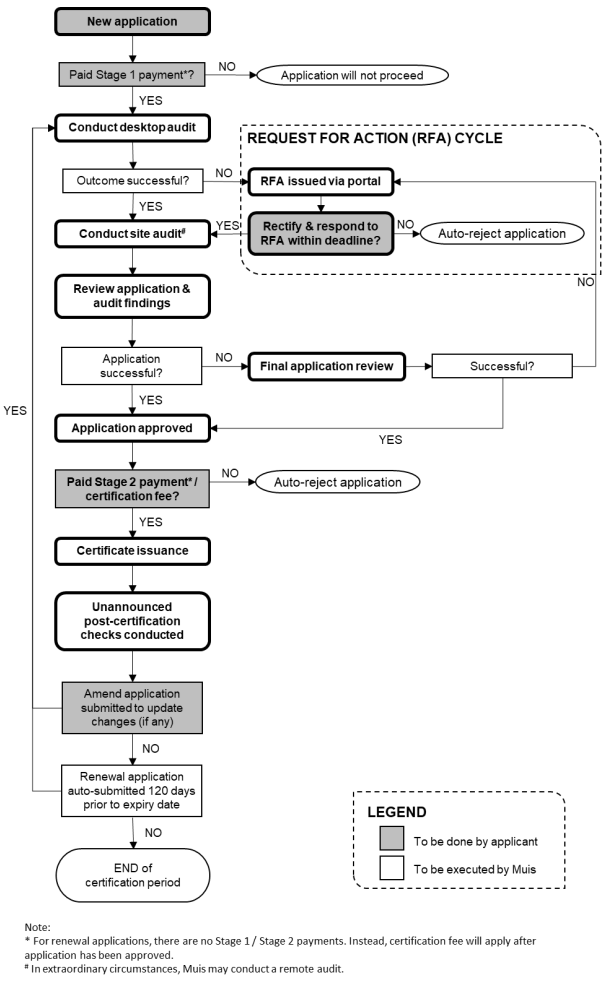 All Halal certification applications must be submitted online through the GoBusiness Licensing Portal.
Applicants are required to pay 100% of the application fee and 40% of the certification fee upfront.
Once payment is made, the application will undergo processing and verification to confirm compliance with the Halal Certification Conditions.
Afterwards, a certification audit will be conducted, during which an auditor will visit the premises to assess compliance. Any identified non-conformities must be rectified within the specified deadline, followed by a re-audit to confirm the full compliance.
Processing of the application will commence within 14 working days upon receipt of payment for new (normal) applications, and within 7 working days for new (express) applications.
The overall timeline for certification is dependent on how quickly the applicant addresses and rectifies any issues identified by Muis during the audit process. As with all audits, certification can only proceed once all non-conformities are resolved.
It is recommended to regularly log in to the GoBusiness Licensing Portal to monitor your application status, respond to any notices of non-compliance, and review audit reports.
Upon approval, an invoice will be sent to the email address provided in the application, indicating that the Halal certificate is ready for collection.
The remaining 60% of the certification fee must then be paid before the certificate can be issued. After final payment:
Products under the PRO Scheme will receive a Halal certificate.
Products under the EN Scheme will receive a Halal Endorsement Letter.
Halal certificates are valid for the period stated on the certificate, typically one or two years. Renewal requests continued compliance with the prevailing Muis Halal Certification Conditions.
Renewal applications are automatically generated 120 days before the certificate’s expiry. While automated email reminders may be sent, applicants are strongly encouraged to proactively check the GoBusiness Licensing Portal for updates.
Halal Endorsement Letters are valid only until the expiry date of the product in the respective shipment and are not renewable.
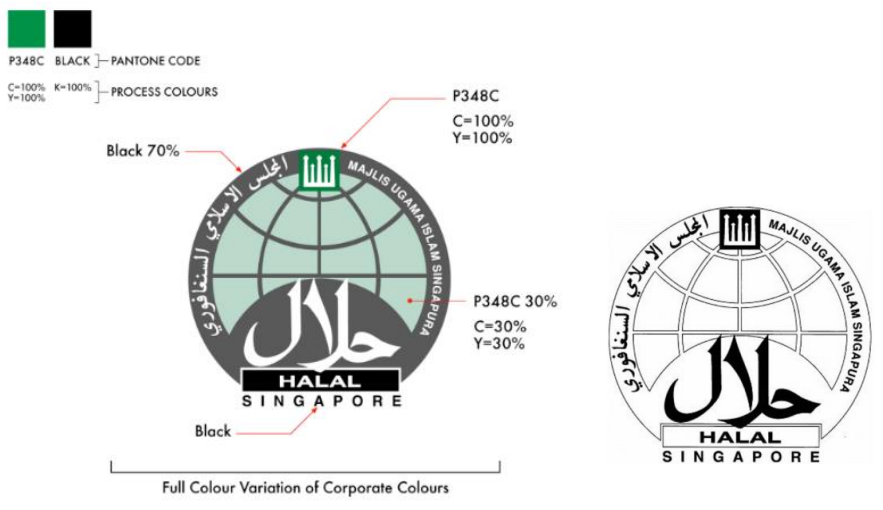
3.6 Halal Logo
All companies / establishments applying for a halal certification from Muis may, upon fully complying to the Muis Halal Certification Conditions, be issued a Muis Halal certificate and allowed to use Muis Halal certification mark upon the terms and subject to conditions provided therein.
The Halal certification mark must be printed directly on the product packaging, accompanied by the manufacturer's Customer Code assigned by Muis (e.g., C1234). Labeling requirements for the certification mark include:
It must be used in its original proportions and may be resized proportionally;
The resolution must be high enough to ensure all wordings are clearly legible;
The mark must appear in its official colors or in black and white;
It must not exceed or be more prominent than the company’s own branding.
Figure 6: Singapore Halal Logo
 For imported products under the EN Scheme, once the Halal Endorsement Letter is issued, the applicant may affix the tamper-proof Muis halal certification mark on the carton or product itself, alongside the halal mark of the original certifying body from the country of manufacture.
 4. Thailand
Thailand is an open society recognized for its diverse food industry and rich culinary heritage, which maintains stability and unity despite differences in belief and religion. Islam is the largest minority religion in Thailand. Halal certification for cosmetics is voluntary in Thailand.
4.1 Key Halal Regulations
Regulation | Main Content | Publish Date |
Regulation of the Central Islamic Council of Thailand on the Management of Halal Affairs B.E. 2558. | It establishes standards and quality control measures for Halal products, including the use of the Halal logo. | November 24, 2015 |
Regulation on the Requirements for Certification Process of Halal Products B.E. 2559. | It defines the requirements for the Halal certification process. | May 23, 2016 |
It sets the conditions for requesting and using the Halal certification logo on products and packaging. | 2016 |
4.2 Competent Authorities
In Thailand, the Central Islamic Council of Thailand (CICOT) is the official body overseeing halal certification for food products. Its role includes overseeing the registration of halal-certifiable businesses, providing guidance on halal standards, and auditing food production processes to ensure compliance with Islamic dietary laws.
The Halal Standards Institute of Thailand (HSIT) plays a crucial role in the certification of halal products in Thailand. Established to standardize halal practices, HSIT aims to ensure that all products and services labeled as halal meet the requirements set forth by Islamic law. Halal certification is essential not only for local businesses but also for international trade, catering to the growing demand for halal products globally.
4.3 Requirements for Halal Cosmetics
To apply for halal certification in Thailand, entrepreneurs must fulfill the following requirements.
1) Separate Production Areas: The production area of Halal products must be clearly separated from that of non-Halal products.
2) Halal-compliant Ingredients: All raw materials and ingredients used in the production must be traceable for ensuring they are Halal and not mixed with any substances prohibited under Islamic law.
3) Clean and Compliant Equipment: All production equipment must be clean and comply with Islamic requirements. It must not be used with any prohibited substances.
4) Approved Raw Materials: Only raw materials permitted under Islamic law may be used in Halal production.
5) Animal-derived Ingredients: If animal-derived ingredients are used, the animals must be of a type permissible under Islamic dietary laws.
6) Proper Handling and Storage: Storage, transportation, and distribution must be carried out in a way that prevents any contact with prohibited substances.
4.4 Halal Certification Procedures
Foreign companies may choose one of the following two methods for halal certification in Thailand:
1) Applying for a Halal Certificate via CICOT;
2) Certified as Halal by a foreign halal certification body recognized by CICOT (List of recognized foreign halal certification bodies).
Procedures for Applying for a Halal Certificate via CICOT
Figure 7: Procedures for Applying for a Halal Certificate via CICOT (Source: The Central Islamic Council of Thailand, 2016)
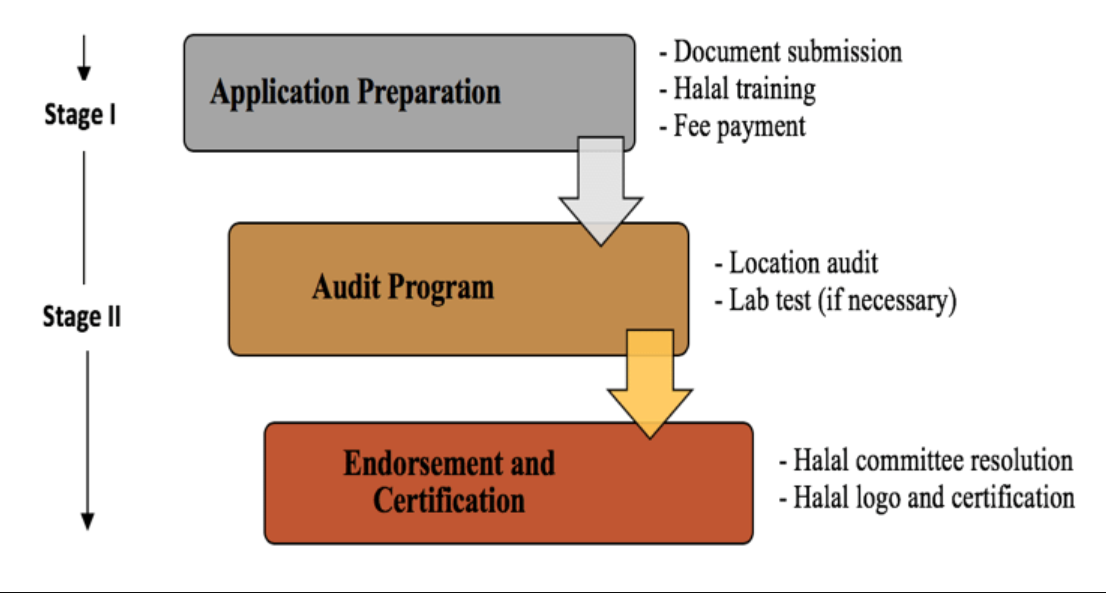 Entrepreneurs seeking to provide audit and certification services for Halal products or Halal services must submit a petition (application) to the Halal Committee using the prescribed form.
To apply for Halal certification, entrepreneurs are required to submit the following documentation to the Committee:
1. Guidelines for the preparation of production facilities, personnel, and training programs for involved staffs.
2. Detailed information regarding ingredients and additives used in the production and service process, along with laboratory analysis reports from laboratories recognized by the Committee.
3. A Halal quality control manual.
4. Any other relevant documents as specified or requested by the Committee.
Upon receipt of the application and supporting documents, the Committee will review the submission to determine whether all requirements have been met. If the documentation is incomplete, the Committee has the authority to request additional information, supporting documents, or laboratory analyses as necessary.
Once the application is deemed complete, the entrepreneur will be notified of the scheduled Halal audit. At this stage, the entrepreneur must pay all applicable certification fees and related expenses.
If the Committee finds the documents satisfactory, a team of Halal auditors will be appointed to conduct an on-site audit at an agreed-upon date and time.
During the audit, Halal auditors will inspect the raw materials, ingredients, production procedures, equipment, manufacturing site, distribution, packaging, and transportation processes. The entrepreneur will receive prior notice specifying the date and time of the audit.
Entrepreneurs are required to fully support the auditors by providing access and facilities necessary for a comprehensive inspection, covering all stages of the manufacturing and/or service processes as required by the auditors.
After completing the inspection, the auditors shall prepare a report summarizing their findings, providing comments and recommendations to the Halal Committee for further consideration.
If the Halal Committee determines that the entrepreneur’s operations fully comply with Islamic principles and the established Halal standards, a Halal certificate will be issued for a specified period, subject to the Committee’s approval.
If the entrepreneur also wishes to use the Halal logo, the Provincial Islamic Committee or the Halal Subcommittee will submit all relevant documents—including the audit report and other required details—to the Board of the Central Islamic Council of Thailand for further action.
If the Board confirms that the entrepreneur’s products or services meet the Islamic provisions and Halal standards, and if all associated logo usage fees have been paid, a license to use the Halal logo will be issued for a specific period as approved by the Committee.
Halal certificate and certificate of using Halal logo both have a validity period of 2 years.
4.5 Halal Logo
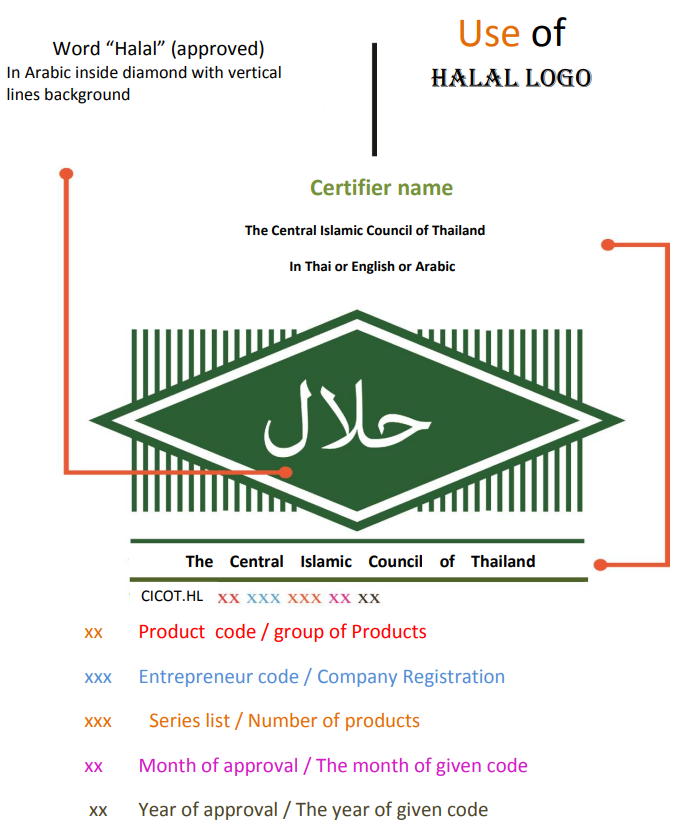
Halal logo is allowed to be used only when the products have been audited and given Halal certificate by the CICOT. The use of the Halal logo on the Halal products on their labels for advertising must comply with the following requirements:
The word Halal written in Arabic;
The word Halal is identified in a rhombus (diamond square);
Behind the frame there are vertical stripes and parallel lines below the rectangle;
The named of office of the CICOT is written in Thai, English, Arabic or other languages between parallel lines.
Figure 8: Thailand Halal Logo
5. Philippines
Despite being a Christian-majority country, the Philippines has a state-sanctioned program to facilitate halal certification of goods under the Halal Act of 2016.
5.1 Key Halal Regulations
The Philippine halal regulatory framework is anchored primarily in Republic Act No. 9997 and Republic Act No. 10817. In addition, a voluntary halal standard for cosmetics and toiletries has been released.
Regulation | Main Content | Effective Date |
Republic Act No. 9997 National Commission on Muslim Filipinos Act of 2009 | The act establishes the National Commission on Muslim Filipinos (NCMF) to safeguard and promote the cultural, educational, economic, and religious rights of Muslim Filipino communities. The Commission is responsible for coordinating policies, promoting Islamic education, and setting halal industry standards. | March 5, 2010 |
The regulation supplements RA No. 9997 with detailed rules and regulations. | December 11, 2014 | |
Philippine Halal Export Development and Promotion Program Act of 2016 (Republic Act 10817) | The act mandates the government to regulate the halal certification of goods in the Philippines and promote halal-certified goods for export. | May 31, 2016 |
The regulation provides detailed rules and regulations supplementing RA No. 10817. | August 10, 2017 | |
Philippine National Standard (PNS) 2161:2021 Halal Cosmetics and Toiletries — General Requirements | PNS 2161:2021 establishes the general requirements for the Halal cosmetics and toiletries and is intended as a tool for local manufacturers to extend their market reach and realize the export potential of Halal cosmetics and toiletries. | 2022 |
5.2 Competent Authorities
1. National Commission on Muslim Filipinos (NCMF)
Established under Republic Act No. 9997, the NCMF is mandated to:
Promote and develop the Philippine Halal industry;
Accredit halal-certifying entities/bodies for the benefit of Muslim Filipinos, in collaboration with relevant agencies, individuals, and institutions domestically and internationally;
Preserve and develop the cultural traditions, institutions, and well-being of Muslim Filipinos;
…
Key programs include the Halal Awareness Program (HAP) and the accreditation of halal-certifying bodies.
2. Philippine Halal Export Development and Promotion Board
Created under Republic Act No. 10817, this Board serves as the policy-making body for Halal export development and is attached to the Department of Trade and Industry (DTI). Republic Act No. 10817 reassigned the task of halal accreditation to DTI's Philippine Accreditation Bureau (PAB). This agency consults the Halal Board in granting or denying accreditation.
The Halal Board's primary functions are to:
Formulate, advocate, coordinate, oversee, and assess the implementation of the Philippine Halal Export Development and Promotion Program;
Direct and coordinate the development and harmonization of Philippine National Standards for Halal by standard-setting agencies, and monitor their application on products, processes, and services through government regulatory agencies;
Spearhead and support the forging of international agreements and the recognition of accredited Halal certification bodies in other countries to open new and expand existing markets for Halal products, processes, and services;
Issue the Philippine Halal Logo and establish guidelines on its proper use;
…
It is important to note that while both the NCMF and the Halal Board are authorized to accredit HCBs, the NCMF's jurisdiction covers halal-certified products for local consumption, whereas the Halal Board focuses on products intended for export.
At the end of 2024, the Philippines launched the National Halal Industry Development Office (NHIDO) under the DTI. This institution supports the government's halal strategy by coordinating all development efforts, engaging stakeholders, and establishing a unified and robust halal industry. NHIDO's key responsibilities include:
Simplifying halal certification and standards for micro, small, and medium enterprises (MSMEs) through capacity-building programs and specialized training;
Promoting public awareness via various media platforms and community outreach initiatives;
Developing a comprehensive halal industry database and establishing monitoring and evaluation systems for data-driven planning.
3. Accredited Halal-certification Bodies (HCBs)
As of 2024, there are 12 accredited halal-certification bodies (HCBs) in the Philippines, namely:
1. Halal Development Institute of the Philippines, Inc. (HDIP)
2. Prime Certification and Inspection Asia Pacific, Inc. (PRIME)
3. Halal International Chamber of Commerce and Industry of the Philippines, Inc. (HICCIP)
4. Mindanao Halal Authority (MinHA)
5. Basilan Ulama Supreme Council Foundation Inc. (BUSC)
6. Fiqhi and Halal Council of the Philippines, Inc. (FIQHI)
7. Muslim Mindanao Halal Certification Body (MMHCB)
8. Philippine Ulama Congress Organization, Inc. (PUCOI)
9. Maslaha Halal Certification Board, Inc (MASLAHA)
10. Phil. Liguasan Marsh Conservation and Socio-Economic Development Inc. (PHILCOSED 2015)
11. Bangsamoro Provincial Consultative Council, Incorporated (BPCC)
12. Alliances of Halal Integrity of the Philippines, Inc. (AHIP)
5.3 General Steps for Obtaining Halal Certification
Halal certification verifies that products, processes, services, and systems adhere to halal standards through independent and ethically sound audits. Before a product can feature a halal label, it must undergo inspection by recognized organizations—typically non-profit Philippine Muslim People's Organizations (MFPO) or Muslim Non-Governmental Organizations (MFNGO)—which serve as Halal Certification Bodies (HCBs).
The Philippines currently employs a voluntary halal certification system. Interested parties may secure certification from accredited local bodies. However, Philippines lacks a unified national standard or regulation for halal certification, while various HCBs operating based on their own guidelines.
While specific procedures may vary among different HCBs, the general process for businesses seeking Halal certification typically includes:
1. Application Submission: Businesses apply to a HCB to initiate the process by providing necessary documents such as company details, product information, and manufacturing processes.
2. Inspection and Audit: The HCB conducts a comprehensive inspection and audit of the documents and production facilities to ensure compliance with Halal standards.
3. Compliance and Rectification: If any non-compliance issues are identified during the audit, the business must address and rectify them to meet Halal requirements.
4. Certification Issuance: Upon meeting all Halal standards, the HCB issues a Halal certificate, which is typically valid for a specified period. Re-certification may be required upon expiration.
5.4 Halal Logo
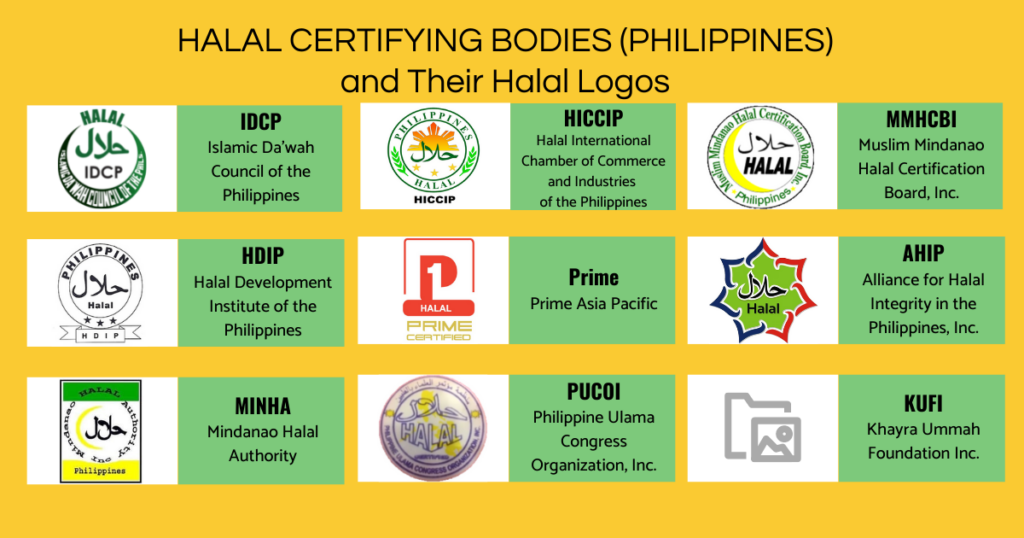
After obtaining Halal Certificates from accredited HCBs, certified products can carry a halal logo on the packaging. Same as the halal certification requirements, the halal logo vary among the HCBs.
Figure 9: Part of Halal Logos from HCBs in the Philippines
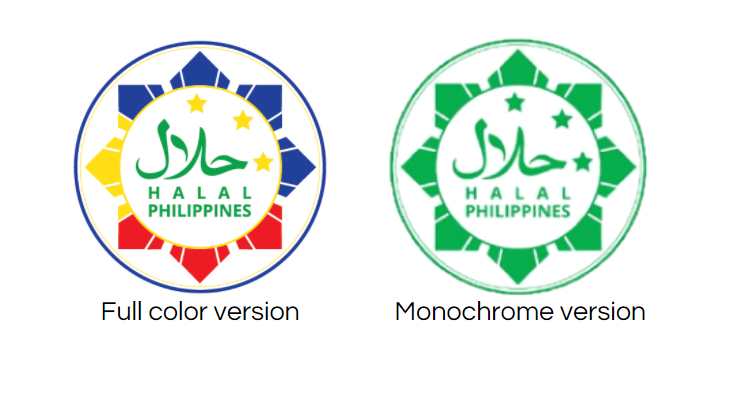
 In 2019, the Philippine government introduced a national Halal logo to distinguish halal-certified products made in the country with two versions:
A monochrome version for labeling purposes, aimed at reducing printing costs;
A full-color version for use in other printed materials.
The right to use the national Halal logo is granted to companies whose products, processes, or services are certified as Halal by accredited HCBs.
Importantly, even after the introduction of the 2019 national logo, the existing logos of HCBs—whether accredited by PAB or not—may still be used domestically.
However, for products, processes, or services intended for export, companies are required to use the official green-and-white national Halal logo. This may be used alongside the certifying HCB's own logo if the HCB mandates its inclusion.
Figure 10: Philippines National Halal Logo
5.5 Future Trends
In January 2024, the Philippines unveiled the four-year Philippine Halal Industry Development Strategic Plan to harness these opportunities. Key objectives of the plan include:
1. Increasing Halal output to meet the growing domestic and international demand;
2. Establishing a national brand to position the Philippines as the leading Halal-friendly hub in the Asia Pacific;
3. Creating a one-stop shop to facilitate stakeholder coordination;
4. Building a comprehensive Halal value chain through regional development, knowledge management, skills development, investment promotion, and capacity building.
6. Vietnam
With its strategic geographic location and strengths in agriculture, food production, and tourism, Vietnam holds significant potential to expand into the global halal market. Vietnamese enterprises have been growing opportunities in this sector; however, the development potential of halal products is underexploited.
Currently, in Vietnam, the most commonly halal certified product categories include aquatic products, beverages, fruits, vegetables, and general food items. Vietnam lacks a government-recognized halal certification body. As a result, businesses seeking halal certification must apply through an independent halal certification agencies, generally following these steps:
1. Compliance Preparation: Ensure that products conform to Islamic laws and do not contain any prohibited (haram) ingredients.
2. Document Submission: Prepare and submit required materials to the selected halal certification body.
3. Review and Inspection: The certification body conducts a thorough evaluation, including document review, on-site inspections, and potentially product testing.
4. Certification: Upon approval, the company receives a halal certificate and may affix the halal logo to certified products. The certificate is typically valid for a defined period and must be renewed upon expiry.
6.1 Recent Developments in Halal Regulatory Framework
To address regulatory gaps and align with international expectations, Vietnam has taken steps toward establishing a national halal system. In 2023, the Ministry of Science and Technology (MOST) introduced a National Halal Standards Assessment System, referred from halal standards from key export markets such as Saudi Arabia, Malaysia, Indonesia, and the Philippines, and issued a decision to establish the National Halal Certification Center (HALCERT) under the Conformity Certification Center. Its roles include advising on halal policy, conducting certification and research, promoting international cooperation, and supporting development initiatives in the halal sector.
6.2 Draft Decree on Halal Product and Service Management (2024)
On June 25, 2024, MOST solicited public comments on a draft decree governing the management of halal products and services. The draft is a response to rising domestic and global demand for halal-certified offerings, and lays the groundwork for a formal halal regulatory regime in Vietnam.
Key Provisions of the Draft
The draft outlines several key points crucial to the management of halal products and services in Vietnam. Certain aspects still lack detailed requirements and need to be developed afterwards.
Firstly, it mandates compliance with relevant published standards and Islamic regulations governing halal products. Since halal standards are different in different countries, to help Vietnam expand the overseas halal market, the MOST will study and formulate Vietnam’s national standard mainly by taking reference from Codex Standards and the halal standards in Vietnam’s key exporting countries, such as Saudi Arabia, Malaysia, Indonesia, etc.
Secondly, regarding the product label, the draft requires organizations and individuals involved in producing, exporting, importing, or circulating halal products in Vietnam to clearly mark packaging, labels, and/or accompanying documents with the applicable halal standards. This includes adherence to Vietnamese laws on product labeling. In addition, enterprises also need to label halal certification mark. Imported halal products that are certified by an authorized organization from their exporting country as conforming to international standards, are permitted to use the exporting country's halal product certification mark.
Thirdly, this draft also includes chapters for assessment activities of halal product & service, inspection activities and penalties for violations.
Lastly, to support and promote the exportation of Vietnam’s halal products, the draft revealed that Vietnam will promote signing agreements with Muslim-majority countries and issue policies to build Vietnam’s brand and support enterprises, etc.
Vietnam is actively moving toward establishing a unified, government-led halal certification framework to support its growing halal export ambitions. These regulatory advancements aim to streamline certification, improve international credibility, and unlock the full potential of Vietnamese halal products in the global market.
